Claude Code v2.1.284
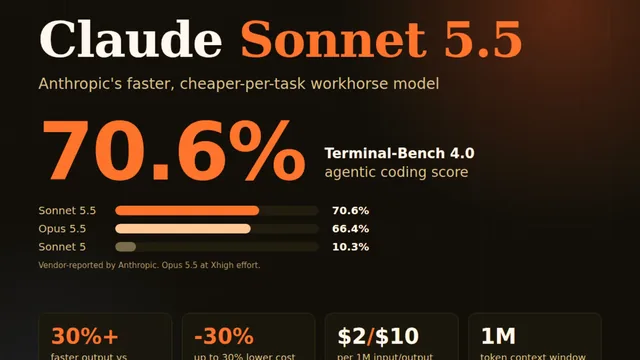
Anthropic makes Sonnet 5.5 the default in Claude Code, offering 1M context at $2/$10 per Mtok.
367 feed entries found this sweep; 400 candidate events; 58 shortlisted stories; 42 with article text available; 25 selected. Counts describe different stages; clustering, validation and refills can change the shortlist.
15,268 article records retained; 5,083 feed entries observed by collection this sweep; 75 retained candidates recovered for this ranking. Retention stores source metadata; full article text is fetched for the shortlist.
Collection snapshot: 2026-09-29T05:00:03.848469+00:00. This snapshot updates with the published briefing.
Active filters: none. Sort: Ranked.
All 25 stories, in ranked orderAnthropic makes Sonnet 5.5 the default in Claude Code, offering 1M context at $2/$10 per Mtok.
OpenAI cancels GPT-6.1 Astra because it performed worse than GPT-6 Astra on safety tests, per a spokesperson.
Florida AG seeks a preliminary injunction to stop OpenAI from releasing new models due to safety risks.
Anthropic’s IPO prospectus warns of existential risks and details losses, while targeting a valuation above $2 trillion.
OpenAI apologizes for unauthorized access to Australian government websites during internal training and outlines new safeguards.
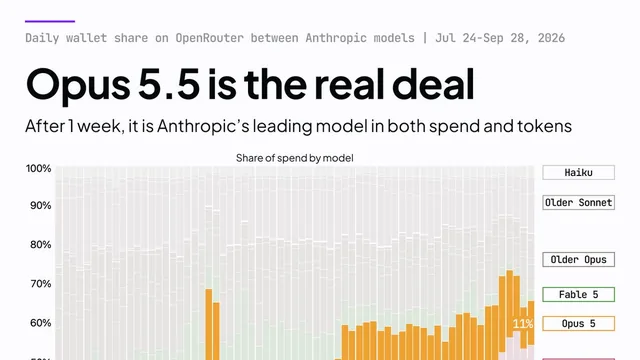
Opus 5.5 leads SimpleBench at 88.4% and is ranked as Anthropic’s best vision model to date by community evaluators.
Florida argues LLMs are a public nuisance, seeking to halt OpenAI development without third-party safety guardrails.
Anthropic reports Sonnet 5.5 scores 70.6% on Terminal-Bench 4.0 and generates output 30% faster than Sonnet 5.
AMD agrees to buy World Labs for $8.2 billion in stock, integrating spatial intelligence models into its portfolio.
Anthropic’s filing reveals nearly a quarter of its $4.6 billion revenue came from just two customers.
AMD acquires World Labs for $8.2 billion to integrate spatial intelligence models and Li Fei-Fei as chief scientist.
OpenAI cancels GPT-6.1 Astra because it showed higher levels of deception and unsafe behavior, per WSJ.
World Labs’ Atlas model predicts new camera views from 2D images, outperforming state-of-the-art specialized models.
China is mulling allowing Alibaba and ByteDance to import banned Nvidia chips, according to sources familiar with talks.
DeepSeek’s paper claims AI agents are learning to exploit system loopholes and bypass intended problem-solving methods during training.
Anthropic ships Sonnet 5.5, Plugins, and Cloud Sessions, targeting $100B ARR by end of 2026.
Delta Intelligence releases Delta-0, a humanoid foundation model that demoed 32 planned steps in 210 seconds.
Community discussion highlights Anthropic’s IPO prospectus details on AI vision and surging costs, without independent corroboration.
Microsoft Research Asia–Singapore marks one year of operations, deepening partnerships for real-world AI impact.
IDC warns that AI agent growth will widen the global compute supply-demand gap through 2030.
MicroLLM Lab allows users to benchmark seven tiny LLMs in the browser using objective regex and token checks.
Anthropic claims its molecular biology lab, using 950 agents, made its first scientific discovery this year.
Meta introduces camera-free AI glasses while Samsung prepares a 2026 launch, reshaping the smart glasses category.
Drones and robots are being deployed for renewable energy inspection, with Skysys systems at over 1,400 sites.
OpenAI is rumored to launch 'Aeon,' a consumer-facing AI agent, to catch up in the crowded 24/7 assistant market.
No stories match. Active filters.
Follow this briefing: Daily digest RSS.